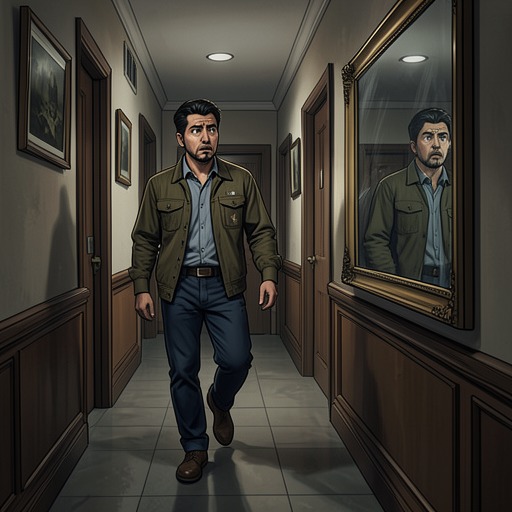
Futh gets lost while hiking
The Lighthouse (Alison Moore Edition)Futh gets lost while hiking during his Rhine walking holiday, an episode in which a small navigational mistake expands into hours of wasted effort and a diminished sense of control. With a map that cannot restore his bearings and a broken compass in his pack, he walks for hours in the wrong direction. Finding help sets him back on course, but not without a physical cost; the delay also unsettles his plans for the journey’s final day and a possible visit to Carl in Utrecht.
The Mistake and the Broken Compass
By early afternoon, Futh’s feet are already burnt: the skin between his sandal straps is hot and pink, while the covered bands remain blue-white. It is against this bodily discomfort that he realizes he is lost. Standing in a field, he studies his map and looks for landscape features that should be visible but are not. The map offers information without recognition; he cannot match its markings to the ground around him.
Futh has The compass from Kenny’s room, but it gives him no useful direction. He eventually understands that it is broken. The sun is high overhead and does not help. He looks back along the trampled-grass path he has taken and considers retracing his steps, but cannot identify where the error began: there may have been several points at which he missed a turning or wandered off while lost in thought. The uncertainty makes a simple reversal difficult. He knows he is misplaced, but not where his route first went wrong.
Asking for Directions
Rather than turn back without a clear plan, Futh decides to continue until he finds someone who can tell him where he is and which way to go. He walks for well over an hour without seeing anyone or finding shelter from the sun. In a small village, he approaches a man smoking outside a house and asks for his location in German, holding out the map.
The encounter brings together two kinds of sensory detail: the man’s cigarette smoke and the smell of baking drifting from a kitchen window behind him. As the man studies the map, ash from his cigarette spills into its folds. When he points out Futh’s position, the extent of the detour becomes clear: Futh has been walking in the wrong direction for hours, and now has at least as far to go as he did after breakfast, perhaps farther. Asked where he has come from and where he is headed, Futh explains; the man tells him that he wants to go in the opposite direction.
The woman in the kitchen has moved out of sight by the time the man returns the map. Futh thanks him and walks away slowly. The smoke and baking smell fade, leaving ash on his fingertips and saliva in his mouth. The brief exchange supplies the direction his compass could not, but it does not erase the lost distance or the effort already spent.
The Physical Cost and the Return Route
Futh retraces his steps and this time takes the path leading to his last stop before Hellhaus. The route has no signpost: it passes through an opening in a hedge, a narrow gap between one small path and another. He is not surprised that he missed it on the first attempt, and even now he cannot be certain that he is going the right way. His sunburnt feet and new blisters make each step more painful, with his sandal straps sawing against his skin.
By the time he reaches his hotel, he is exhausted. He runs a bath, takes small bottles from the room’s fridge, and goes onto the balcony, where he can see the river. He thinks he is almost close enough to jump into the water from there. He has not eaten since breakfast and has arrived too late for dinner; after his bath, he will have to make do with a bar snack. The mistake thus narrows his choices at the end of the day as well as lengthening the walk: he arrives tired, hungry, and with his planned evening already lost.
The Detour’s Aftermath
The next dawn, stiff and hungry, Futh considers skipping the final day of walking and going to Utrecht instead. Carl had invited him, and Futh thinks he might remember the way to Carl’s mother’s house even without the address. But first he would need to collect his car from Hellhaus. He considers taking a bus there with his suitcase, rather than risking its arriving later by transit, and imagines reaching Utrecht around lunchtime after leaving directly after breakfast. This possible change of plan grows out of the preceding day’s fatigue and delay, but remains only a possibility.
Futh cannot find a bus timetable at the hotel, so he goes out to look for a stop and eventually finds one near the river, about a mile from the centre. After taking a quiet break and eating his lunch, he reaches the stop in time. When the bus does not appear, he checks nearby timetables and rechecks the first one, wondering whether he has mistaken the time or the day. After almost an hour, he concludes that the bus may not be coming or that he may have arrived just after it left. He considers hitchhiking, but no one stops; rather than walk back into town to seek an expensive taxi, he waits for the evening bus.
That bus takes him to the wrong stop, so he has to walk again before reaching Hellhaus. Before going to the hotel to ask about his suitcase, he checks his car and finds a flat tyre. Broken glass lies in the gutter, but the immediate obstacle is that the spare in the boot is an old, flat tyre—the one he removed beside the road before driving home and finding Kenny leaving Angela’s house. Futh gives up on Utrecht and returns to the itinerary he had already planned, hoping for rest and the practical comforts of his room. The episode’s sequence of wrong paths, missed transport, and a disabled car makes navigation more than a matter of finding a line on a map: every attempted correction encounters another delay.
A Recurring Pattern of Misdirection
The hiking mistake echoes Futh’s earlier difficulty on the motorway, when he realized that he had missed a turning and, unable to turn around between junctions, continued in the wrong direction. On that earlier journey, he remembered being a passenger with Angela and an atlas, silently watching the signs contradict the route he hoped was right. In both episodes, evidence accumulates before he can act decisively: the map, the road signs, or the local man’s finger makes the mistake visible, but recognition comes after distance has already been lost.
The episode also begins against the wider pattern of Futh’s travel in the novel. He moves from the ferry toward his first drive in another country, but travel repeatedly exposes the gap between movement and control. Here, the failed compass and unmarked opening in the hedge make that gap literal. The local man can give him a direction, yet Futh must still walk the distance back, endure his injured feet, and accept the disrupted itinerary. Being found again is a practical correction, not a recovery of the time and certainty the detour has taken.